
Secondary School Retrofit
Sector
Institutional
Location
Amherstburg, Ontario
Year
2025
Sketchup, Enscape, Revit
Fort Malden Secondary School is a renovation and retrofit on the existing North Star High School in Amherstburg, Ontario. Renamed in honour of the town’s historical landmark, the Fort Malden project embraces education and community driven design to foster a fulfilling and encouraging learning environment.
Following its opening in 2022, students and staff were quick to notice architectural issues with North Star High School. Poor circulation is the most pressing issue with overcrowding in the singular, long hallway during class transition periods, which has resulted in accessible travel between classrooms for some students. North Star also lacks sufficient programming and fails to provide enhanced educational opportunities, such as an auditorium and classes that cater to the town’s agricultural industry. As well, the existing programming currently suffers from inefficiencies in layout and acoustic regulation with quiet spaces like the library located between the cafeteria and gymnasium.

A strategically designed second floor was introduced to increase student capacity while improving overall circulation efficiency and optimizing the placement of key amenities. This addition allows for a more cohesive spatial organization and supports improved movement throughout the building.
The main entrance was relocated to a more centralized position within the school to enhance accessibility and strengthen internal circulation patterns. A prominent architectural canopy was incorporated to clearly define and emphasize the newly reimagined entry, establishing a strong and welcoming sense of arrival. In parallel, the exterior landscaping was expanded to support student interaction, providing enhanced gathering spaces and increased outdoor seating opportunities that promote social engagement.


The front entrance was strategically relocated to the newly constructed atrium, which now functions as a central gathering hub for students. This space enhances circulation, improves accessibility, and fosters social interaction, creating a clear and welcoming point of arrival within the facility.
An auditorium was incorporated into the school design to address the previous absence of a dedicated performance and assembly space. While supporting educational programming, the auditorium is also designed to accommodate public events, promoting community engagement and enabling flexible, multifunctional use.
The cafeteria was strategically relocated and enclosed within a more secluded area of the school to minimize noise transmission and improve the overall acoustic environment. This relocation enhances the functionality of adjacent learning spaces while providing a more comfortable and focused dining experience for students.
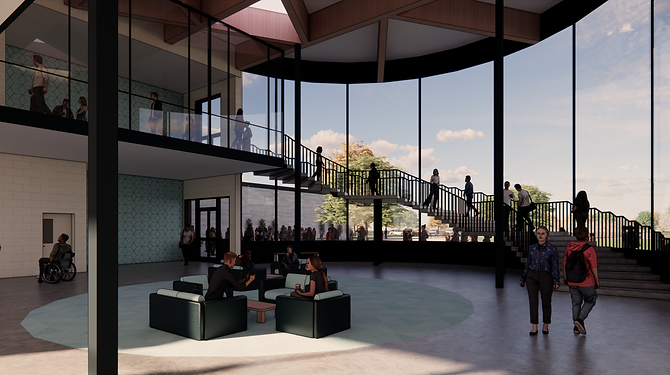


The library was relocated to the newly constructed second floor to create a more secluded and acoustically controlled environment that supports focused learning, quiet study, and academic collaboration. Its elevated placement enhances separation from high-traffic areas while maintaining accessibility for students and staff.
Hallway alcoves were strategically integrated throughout the circulation network to improve pedestrian flow and reduce congestion within primary corridors. By recessing lockers into these alcoves, the design eliminates the need for double-loaded lockers along main hallways, resulting in wider, clearer circulation paths. In addition, these alcoves provide informal gathering and idle spaces for students, supporting social interaction while maintaining an unobstructed and efficient central passageway.
